Personalized Medical Care & Dedicated International Patient Concierge

Medical Guide
High-Intensity Laser Therapy (HILT) for Joint Pain
How high-intensity laser therapy (HILT) works for joint and tendon pain, the honest evidence, and the US regulatory facts, from a Seoul orthopedic clinic.
Schedule a ConsultationHigh-Intensity Laser Therapy (HILT) for Joint Pain
Medically reviewed by Dr. Heejun Kim, Board-Certified Orthopedic Surgeon, Chief Director, Nucellin Orthopedic Clinic
High-intensity laser therapy, usually shortened to HILT, is a non-invasive treatment that uses focused light energy to target painful joints, tendons, and muscles. It is one of several device-based therapies used to support musculoskeletal recovery, and it is often discussed alongside options such as shockwave therapy. This article explains what HILT is, how a session works, what the research honestly shows, and how it compares with other approaches. It is written for international patients researching HILT at Nucellin Orthopedic Clinic in Seoul who want a realistic picture rather than marketing language.
Here is the most important context up front: laser and photobiomodulation devices are cleared by the U.S. Food and Drug Administration through the 510(k) pathway only as adjunctive devices for the temporary relief of minor muscle and joint pain and for a temporary increase in local blood circulation. They are not cleared as cures, and they are not cleared to make tissue-regeneration claims. Care at Nucellin Orthopedic Clinic is delivered in the Republic of Korea under Korean medical regulation, not under U.S. regulation. HILT is used as an adjunct, meaning it supports a broader care plan rather than replacing it, and no outcome is guaranteed. Results vary between individuals, and the quality of the underlying evidence is limited.
What HILT Actually Is
Laser therapy delivers light of a specific wavelength into tissue, where it is absorbed by cells. The general concept behind this family of treatments is called photobiomodulation: the idea that certain wavelengths of light can influence cellular activity, which may in turn affect pain signaling and local blood flow. Lower-powered versions of this idea are often called low-level laser therapy or "cold laser." HILT sits at the higher-power end of the same spectrum.
Because it uses more power, HILT is designed to deliver energy more deeply and more quickly than lower-level lasers, which is why it is sometimes described as a deep tissue laser therapy. The higher power also means the equipment must be operated carefully by a trained clinician, with appropriate eye protection and attention to skin temperature. It is important to keep the terminology honest: "high-intensity" describes the device's output, not a guaranteed increase in benefit. More power does not automatically mean more healing.
How a HILT Session Works
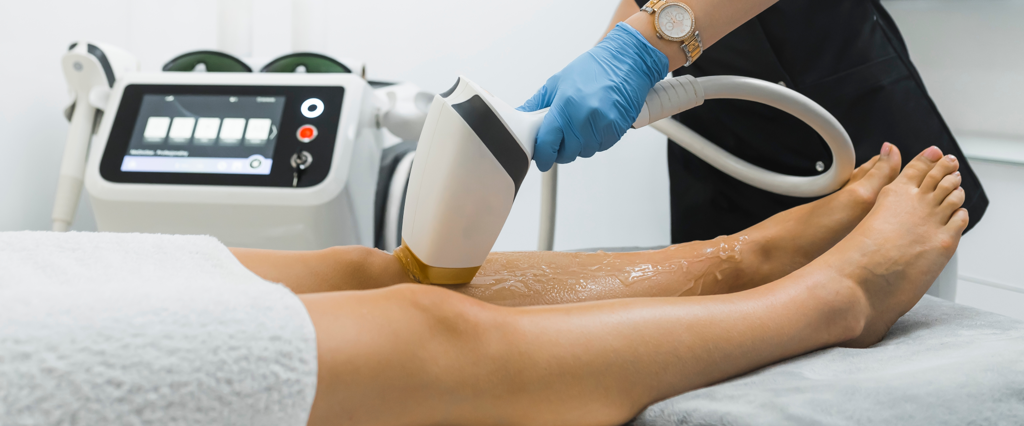
A HILT session is straightforward and non-invasive. There are no needles and no incisions. The clinician moves a handpiece over the treatment area, and the laser delivers energy to the tissue beneath the skin. Many patients feel a gentle warmth during treatment, which is normal, and the clinician adjusts settings to keep the sensation comfortable. Protective eyewear is used for both the patient and the operator because laser light can be harmful to the eyes.
Sessions are typically short, often lasting several minutes to around fifteen minutes depending on the area being treated, and HILT is usually delivered as a course of several sessions rather than a single visit. There is generally no downtime afterward, so most people return to their usual activities directly. The exact number of sessions, the interval between them, and the settings used are individualized based on the condition and the clinician's judgment; they are not a fixed formula that applies identically to everyone.
The Evidence: Honest and Nuanced
This is where honesty matters most. Systematic reviews of HILT for musculoskeletal conditions, such as chronic neck pain, low back pain, shoulder problems, and knee osteoarthritis, have reported some improvements in pain and function compared with control treatments. That is a genuinely encouraging signal, and it is one reason HILT continues to be studied and used as an adjunct.
At the same time, the limitations are real and should not be glossed over. The overall body of evidence is generally rated as low-to-moderate quality, and many individual studies carry a high risk of bias. Trials often involve small numbers of participants, short follow-up periods, and differing laser settings, wavelengths, and treatment protocols, which makes results hard to compare and hard to generalize. In plain terms: HILT may help some patients with certain conditions, the signal is promising but not definitive, and the confidence we can place in it is limited by the quality of the research. No result can be guaranteed, and any claim that HILT reliably heals or regenerates tissue would go beyond what the evidence and the device clearances support.
HILT Versus Shockwave Therapy
Patients frequently ask how HILT compares with extracorporeal shockwave therapy (ESWT), since both are non-invasive, device-based options often used for tendon and joint problems. They are, however, quite different in how they work.
Shockwave therapy delivers mechanical acoustic energy, essentially pressure waves, into tissue. In the United States, ESWT is FDA-approved or cleared for specific indications, chronic proximal plantar fasciitis and lateral epicondylitis (tennis elbow), in adults after conservative care has failed; other musculoskeletal uses are considered off-label. Some patients find shockwave sessions briefly uncomfortable because of the mechanical impulses.
HILT delivers light energy rather than mechanical energy, and it is generally experienced as a warm, painless treatment. Its regulatory status is different too: laser devices are 510(k)-cleared as adjunctive tools for temporary relief of minor muscle and joint pain, not approved for specific conditions the way ESWT is for its two indications. Neither therapy is a cure, and neither guarantees a particular result. Which option, if either, is more appropriate depends on your diagnosis, the tissue involved, and your goals, and that is a decision to make with a physician after an examination rather than from an online comparison.
HILT for Tendon Injuries and Joint Pain
Tendon problems, such as those affecting the shoulder, elbow, or Achilles, are among the conditions for which laser therapy is commonly used as an adjunct. The rationale is that supporting local circulation and modulating pain may help a rehabilitation program proceed more comfortably. It is worth being clear about what this does and does not mean: laser therapy is best understood as a supportive component that can complement exercise-based rehabilitation, activity modification, and other measures, rather than as a stand-alone fix for a damaged tendon.
The same logic applies to joint pain, including pain related to osteoarthritis. HILT may help reduce discomfort and support function for some patients, which can make it easier to stay active and engaged in a rehabilitation plan. But it does not regrow cartilage, it does not reverse arthritis, and it should not be presented as doing so. Framing HILT as an adjunct that may ease symptoms, within realistic limits, is both more honest and more useful than framing it as a repair therapy.
Recovery Time and What to Expect
One of the practical attractions of HILT is that it is non-invasive and usually involves no downtime. Most people can walk in, receive treatment, and return to normal activities the same day. Because there is no incision and no injection, there is no wound to care for. Some patients notice mild, temporary warmth or sensitivity in the treated area, which typically settles quickly.
Recovery, in the sense of symptom improvement, is a separate matter from downtime. Any benefit from a course of HILT tends to develop gradually across multiple sessions rather than after a single visit, and the degree of improvement varies from person to person. It is reasonable to ask your clinician what a realistic timeline looks like for your specific condition, how many sessions are planned, and how progress will be measured, so that expectations are set honestly from the start.
Who Might Be a Candidate
HILT is not right for everyone, and suitability is determined by evaluation, not by a website or a symptom checklist. A physician will review your history, examine the affected area, and consider appropriate imaging before recommending anything. Imaging such as X-ray or ultrasound is a diagnostic tool that helps clarify the source of pain; it is not a treatment in itself. Certain situations, such as treating over areas of active cancer, over the thyroid, during pregnancy in some regions, or directly over the eyes, call for particular caution, which is another reason professional assessment matters.
A conservative-first approach is sensible. For many musculoskeletal complaints, activity modification, physical therapy, and time are reasonable starting points, with adjuncts like HILT considered as one part of a broader plan when appropriate. Non-surgical care, including HILT, does not guarantee that surgery can be avoided; what it aims to do is support comfort and function so that rehabilitation can progress.
Why Diagnosis Matters More Than the Device
It is tempting to focus on the technology itself, but the device is only as useful as the diagnosis behind it. Two people with shoulder pain can have very different underlying problems, and the same laser protocol is not equally appropriate for both. That is why a careful history, a physical examination, and appropriate imaging come before any recommendation. A physician who takes the time to establish exactly what is causing your pain is far more valuable than one who applies the same device to everyone.
This matters for expectations as well. When HILT is matched to a suitable patient and a suitable problem, and used as part of a coordinated plan, it has the best chance of being helpful within its real limits. When it is offered as a universal solution or described in regeneration language it cannot support, it sets people up for disappointment. Honest framing from the beginning protects both your expectations and your decision-making.
Cost and Insurance Context
This article does not discuss prices. It is useful to know, however, that elective and adjunctive orthopedic treatments such as laser therapy are frequently not covered by U.S. health insurance, since coverage often depends on whether a treatment is considered established for a specific indication. Coverage rules differ by plan and by country, so confirm the specifics with your own insurer and directly with the clinic.
About the Clinic and the Reviewing Physician
Nucellin Orthopedic Clinic is located at 4F, 71 Dokseodang-ro, Yongsan-gu, Seoul, Republic of Korea, and is a Registered Medical Institution for Attracting Foreign Patients, certified by the Korean Ministry of Health and Welfare. An English-speaking coordinator supports inquiries and interprets during consultations. The clinic's philosophy emphasizes addressing the underlying biological causes of musculoskeletal problems, not only symptoms, within a movement-based rehabilitation framework.
This article was medically reviewed by Dr. Heejun Kim, the clinic's Chief Director and a board-certified orthopedic surgeon (a Korean credential). His background includes training at Yonsei University College of Medicine and an orthopedic surgery residency at Severance Hospital, along with roles as a Clinical Instructor and a Clinical Professorship at the Artificial Joint Center at Severance. He is a regular member of multiple Korean and international societies, including the International Society for Medical Shockwave Treatment (ISMST). To ask about your own situation, visit the clinic website or the contact page.
Frequently Asked Questions
Is HILT approved by the FDA to treat joint pain?
Laser and photobiomodulation devices are cleared in the United States through the 510(k) pathway as adjunctive devices for the temporary relief of minor muscle and joint pain and for a temporary increase in local blood circulation. They are not cleared as cures or as tissue-regeneration treatments. At Nucellin Orthopedic Clinic, HILT is used as an adjunct under Korean medical regulation.
Does HILT actually work?
Systematic reviews report some improvement in pain and function for certain musculoskeletal conditions, which is encouraging. However, the overall evidence is low-to-moderate quality with a high risk of bias in many studies, so benefit cannot be guaranteed and results vary. It is best understood as a supportive adjunct rather than a proven stand-alone treatment.
Is HILT better than shockwave therapy?
They are different treatments, not simply better or worse. Shockwave delivers mechanical pressure waves and is FDA-approved for specific indications such as plantar fasciitis and tennis elbow, while HILT delivers light energy and is cleared as an adjunctive device for temporary minor pain relief. Which is more appropriate depends on your diagnosis and goals, decided with a physician.
Does HILT hurt, and is there any downtime?
HILT is non-invasive and generally painless; many patients feel only a gentle warmth during treatment. There is usually no downtime, so most people return to normal activities the same day. Protective eyewear is used because laser light can be harmful to the eyes.
How many HILT sessions will I need?
There is no universal answer. HILT is typically delivered as a course of several short sessions, and the number, interval, and settings are individualized based on your condition and response. Any benefit tends to develop gradually rather than after a single visit.
Can HILT regrow cartilage or cure arthritis?
No. HILT does not regrow cartilage or reverse or cure arthritis, and it should not be described that way. It may help ease pain and support function for some patients so that rehabilitation can progress, with results that vary and evidence that remains limited.
The Bottom Line
- HILT is a non-invasive laser therapy used as an adjunct for musculoskeletal pain; it is not a stand-alone cure.
- In the United States, laser and photobiomodulation devices are 510(k)-cleared only for temporary relief of minor muscle and joint pain and a temporary increase in local circulation, not for regeneration.
- Systematic-review evidence shows some pain and function benefit but is low-to-moderate quality with a high risk of bias, so results vary and cannot be guaranteed.
- HILT and shockwave therapy work differently; the right choice, if any, depends on your diagnosis and is decided after an examination.
- Care at Nucellin Orthopedic Clinic is delivered under Korean regulation; candidacy is determined by examination and imaging, and HILT does not regrow cartilage or reverse arthritis.
Disclaimer
This article is for general educational purposes only and is not a self-diagnosis tool. It does not replace an in-person consultation, examination, or personalized advice from a qualified physician. Laser and photobiomodulation devices are cleared in the United States only as adjunctive tools for temporary relief of minor muscle and joint pain; HILT is not an FDA-approved cure and is used as an adjunct. Care at Nucellin Orthopedic Clinic is delivered in the Republic of Korea under Korean medical regulation, not under U.S. regulation. No specific result is guaranteed, and individual outcomes vary. Always seek the advice of a qualified health provider with any questions about a medical condition.
More Articles
Continue reading our clinical guides.