Personalized Medical Care & Dedicated International Patient Concierge

Medical Guide
Musculoskeletal Ultrasound: Precision Pain Diagnosis
Learn how musculoskeletal ultrasound evaluation with the Philips EPIQ 5 pinpoints your pain source and guides treatment under Korean medical regulation.
Schedule a ConsultationMusculoskeletal Ultrasound: Precision Pain Diagnosis
Medically reviewed by Dr. Heejun Kim, Board-Certified Orthopedic Surgeon, Chief Director, Nucellin Orthopedic Clinic
When a joint, tendon, or muscle hurts, the most valuable first step is rarely a treatment. It is an accurate answer to a simple question: what, precisely, is causing the pain? Musculoskeletal ultrasound evaluation is one of the tools that helps answer that question. This article explains what musculoskeletal ultrasound is, how it works, what it can and cannot show, and why precise diagnosis shapes the plan that follows. It is written for international patients considering an ultrasound-guided orthopedic assessment at Nucellin Orthopedic Clinic in Seoul who want a clear, realistic understanding of the process.
The single most important point to establish at the outset is this: musculoskeletal ultrasound is a diagnostic imaging tool, not a treatment. It is a class of device that is FDA-cleared for diagnostic imaging in the United States, and it is used to help localize the source of pain and to guide injections in real time. It does not, by itself, treat a condition or guarantee an outcome, and it does not replace the physician's history-taking and physical examination. It complements them. Care at Nucellin Orthopedic Clinic is delivered in the Republic of Korea under Korean medical regulation, and any treatment that follows an ultrasound evaluation is decided on an individual basis.
What Musculoskeletal Ultrasound Actually Is
Ultrasound imaging, also called sonography, uses high-frequency sound waves to create real-time pictures of soft tissues. A small handheld probe, called a transducer, sends sound waves into the body and detects the echoes that bounce back from different structures. A computer converts those echoes into a moving image on a screen. Because it images soft tissue so well, musculoskeletal ultrasound is particularly suited to looking at tendons, ligaments, muscles, nerves, bursae, and the surfaces of joints.
There are a few features that make it distinctive as a diagnostic tool. It uses no ionizing radiation, which is different from X-ray or CT. It produces images in real time, so structures can be watched as they move. And it is dynamic, meaning the physician can examine a tendon or joint while you flex, extend, or rotate the area, which sometimes reveals a problem that a static image would miss. These qualities make it a useful complement to other imaging, not a universal replacement for it.
The Philips EPIQ 5 and How an Evaluation Works
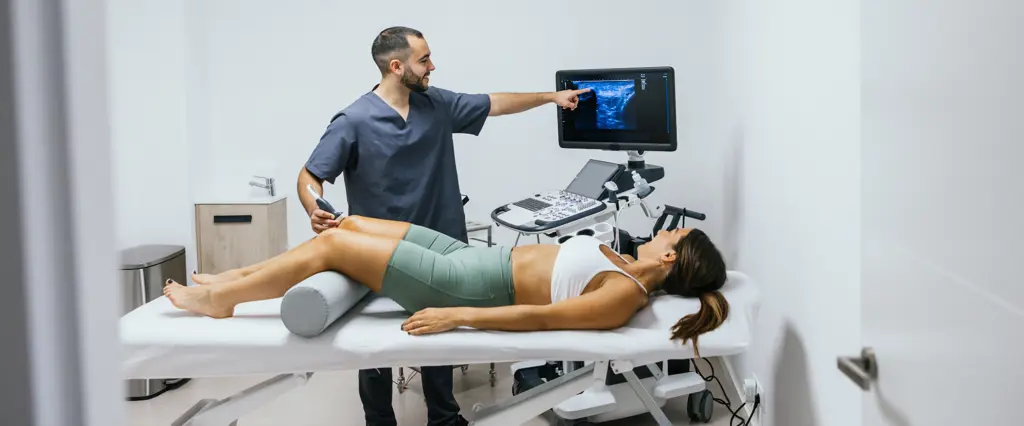
At Nucellin Orthopedic Clinic, musculoskeletal ultrasound is performed using the Philips EPIQ 5 ultrasound system. The evaluation itself is comfortable and non-invasive. A water-based gel is applied to the skin so the probe makes good contact, and the physician moves the transducer over the area of concern while viewing the images on the screen. There is no radiation, no needles for the imaging portion itself, and no downtime afterward.
During the scan, the physician correlates what appears on the screen with your reported symptoms and the findings from the physical examination. Because the study is dynamic, you may be asked to move the joint or muscle so specific structures can be assessed under load or through their range of motion. The result is not simply a set of pictures; it is an interpretation, made by the physician, of what those pictures mean in the context of your particular history and examination.
Identifying the Source of Pain
The central value of musculoskeletal ultrasound is precision in identifying the source of pain. Two people can describe nearly identical shoulder or knee pain and have entirely different underlying problems, and effective care depends on telling those problems apart. Ultrasound can help visualize findings such as tendon thickening or tearing, fluid collections, inflammation of a bursa, or changes at the surface of a joint. By combining these findings with a careful examination, the physician can often narrow down which structure is generating the symptoms.
This matters because a precise diagnosis prevents two common mistakes: treating the wrong structure, and treating a structure that does not need treatment at all. Precision diagnosis at an orthopedic clinic is not about collecting more images for their own sake; it is about making sure that whatever comes next is aimed at the right target. That said, ultrasound has limits. It is excellent for superficial soft tissue but cannot see through bone or deep into a joint the way an MRI can. When the picture is unclear or a deeper structure is in question, the physician may recommend additional imaging. Ultrasound is one part of the diagnostic toolkit, not the whole of it.
Real-Time Guidance for Injections
Beyond diagnosis, one of the most practical uses of musculoskeletal ultrasound is guiding injections in real time. When an injection is appropriate, ultrasound lets the physician watch the needle as it advances and confirm that the material reaches the intended target rather than nearby tissue. This can improve accuracy compared with placing an injection based on surface landmarks alone.
It is important to be precise about what this means. The ultrasound is guiding the placement; it is the underlying diagnosis and the appropriateness of the injection that determine whether treatment is reasonable. Guidance improves accuracy of delivery, but accurate delivery of a treatment does not, on its own, guarantee that the treatment will work. Those remain separate questions, and honest care keeps them separate. Whether an injection is offered at all depends on the diagnosis, the severity of the condition, and your goals, discussed with the physician.
Why Diagnostic Imaging Comes Before Regenerative Treatment
Many patients researching orthopedic care in Korea are specifically interested in regenerative options. Whatever a patient is ultimately considering, diagnostic imaging before a regenerative treatment serves an essential purpose: it helps confirm that the target is appropriate and that expectations are grounded in the actual findings. A treatment aimed at the wrong structure, or at a problem too advanced to respond, is unlikely to help no matter how it is delivered.
This is why the clinic's approach places diagnosis first. Establishing what is wrong, how severe it is, and whether a proposed treatment is a reasonable match must come before any decision about that treatment. It also keeps expectations honest. Imaging is diagnostic, not therapeutic, and identifying a finding on ultrasound is not the same as promising that a particular treatment will resolve it. Regenerative and other elective orthopedic treatments carry their own evidence limitations and are not guaranteed to work; a clear diagnosis simply gives you and your physician a sounder basis for deciding whether to proceed.
How Ultrasound Fits With History and Examination
It would be a mistake to treat any imaging study as the final word. The most reliable diagnoses come from combining three things: a thorough history, a hands-on physical examination, and appropriate imaging. Each contributes something the others cannot. Your account of when the pain started, what makes it worse, and how it affects daily life points the physician toward likely explanations. The examination tests those explanations directly. Imaging such as ultrasound then helps confirm, refine, or rule out what the history and examination suggested.
When these three align, confidence in the diagnosis is high. When they disagree, that disagreement is itself informative and may prompt further evaluation. This is why ultrasound is described as a complement rather than a substitute. A finding on a screen only becomes meaningful when a physician interprets it alongside everything else known about your case. Precision comes from the whole picture, not from any single image.
What to Expect Before and After the Scan
Preparation for a musculoskeletal ultrasound is usually minimal, and your clinician will let you know if anything specific is needed for your case, such as wearing clothing that allows easy access to the area. The scan itself is painless aside from the cool sensation of the gel, and it can typically be completed during a consultation. There is no recovery period, and you can return to normal activity immediately.
After the evaluation, the physician will explain what was seen and how it fits with your symptoms and examination. This is a good moment to ask questions: which structure appears to be involved, how confident the diagnosis is, whether any additional imaging would help, and what reasonable options exist. A clinic that takes time to explain the findings and set realistic expectations is doing exactly what precise diagnosis is meant to enable.
Cost and Insurance Context
This article does not discuss prices. It is worth knowing, however, that coverage for diagnostic imaging and for any treatment that follows varies widely by insurance plan and by country, and elective orthopedic care is often not covered. Confirm the specifics with your own insurer and directly with the clinic. The purpose of an ultrasound evaluation is to inform good decisions, and those decisions should be based on your diagnosis and goals rather than on marketing claims.
About the Clinic and the Reviewing Physician
Nucellin Orthopedic Clinic is located at 4F, 71 Dokseodang-ro, Yongsan-gu, Seoul, Republic of Korea, and is a Registered Medical Institution for Attracting Foreign Patients, certified by the Korean Ministry of Health and Welfare. An English-speaking coordinator supports inquiries and interprets during consultations, which helps international patients understand their diagnosis and options clearly.
This article was medically reviewed by Dr. Heejun Kim, the clinic's Chief Director and a board-certified orthopedic surgeon (a Korean credential). His background includes training at Yonsei University College of Medicine and an orthopedic surgery residency at Severance Hospital, along with roles as a Clinical Instructor and a Clinical Professorship at the Artificial Joint Center at Severance. He is a regular member of numerous Korean and international orthopedic and regenerative-medicine societies, including the International Society for Medical Shockwave Treatment (ISMST). To ask about your own situation, visit the clinic website or the contact page.
Frequently Asked Questions
Is musculoskeletal ultrasound a treatment?
No. Musculoskeletal ultrasound is a diagnostic imaging tool, not a treatment. It uses sound waves to help localize the source of pain and to guide injections in real time, but it does not itself treat a condition or guarantee an outcome. It complements the physician's history-taking and physical examination.
How is ultrasound different from an X-ray or MRI?
Ultrasound uses high-frequency sound waves with no ionizing radiation and shows soft tissues such as tendons and muscles in real time, including during movement. X-ray is better for viewing bone, and MRI can show deeper structures and the inside of joints in more detail. Each has strengths, and your physician may use more than one depending on the question being answered.
Can ultrasound tell me exactly what is causing my joint pain?
It can often help narrow down the source by revealing findings such as tendon changes, fluid, or inflammation, especially when combined with a careful examination. However, ultrasound has limits and cannot see through bone or deep into every joint. When the picture is unclear, additional imaging such as MRI may be recommended.
Why do I need imaging before considering a regenerative or other treatment?
Diagnostic imaging helps confirm that a proposed treatment is aimed at the right structure and that expectations match the actual findings. A treatment directed at the wrong problem is unlikely to help. Imaging is diagnostic rather than therapeutic, and identifying a finding does not guarantee that any particular treatment will resolve it.
Does the ultrasound evaluation hurt?
No. The scan is non-invasive and painless aside from the cool feeling of the gel on your skin. There is no radiation and no downtime, and you can return to normal activity immediately afterward.
Does ultrasound-guided injection guarantee the treatment will work?
No. Ultrasound guidance improves the accuracy of needle placement so that material reaches the intended target, but accurate delivery does not guarantee that a treatment will be effective. Whether an injection is appropriate at all depends on your diagnosis, the severity of the condition, and your goals, decided with the physician.
The Bottom Line
- Musculoskeletal ultrasound is a diagnostic imaging tool, not a treatment; it helps localize the source of pain and can guide injections in real time.
- It uses sound waves with no ionizing radiation, images soft tissue in real time, and can assess structures dynamically as you move.
- At Nucellin Orthopedic Clinic the evaluation is performed with the Philips EPIQ 5 and interpreted alongside your history and physical examination.
- Ultrasound has limits and cannot see through bone or deep into every joint, so additional imaging such as MRI is sometimes needed.
- Imaging is diagnostic rather than therapeutic; it informs decisions but does not guarantee outcomes, and care is delivered under Korean medical regulation.
Disclaimer
This article is for general educational purposes only and is not a self-diagnosis tool. It does not replace an in-person consultation, examination, or personalized advice from a qualified physician. Musculoskeletal ultrasound is a diagnostic imaging tool, not a treatment, and it does not guarantee any outcome; care at Nucellin Orthopedic Clinic is delivered in the Republic of Korea under Korean medical regulation, not under U.S. regulation. Any treatment that may follow an evaluation is decided on an individual basis, and results vary. Always seek the advice of a qualified health provider with any questions about a medical condition.
More Articles
Continue reading our clinical guides.